
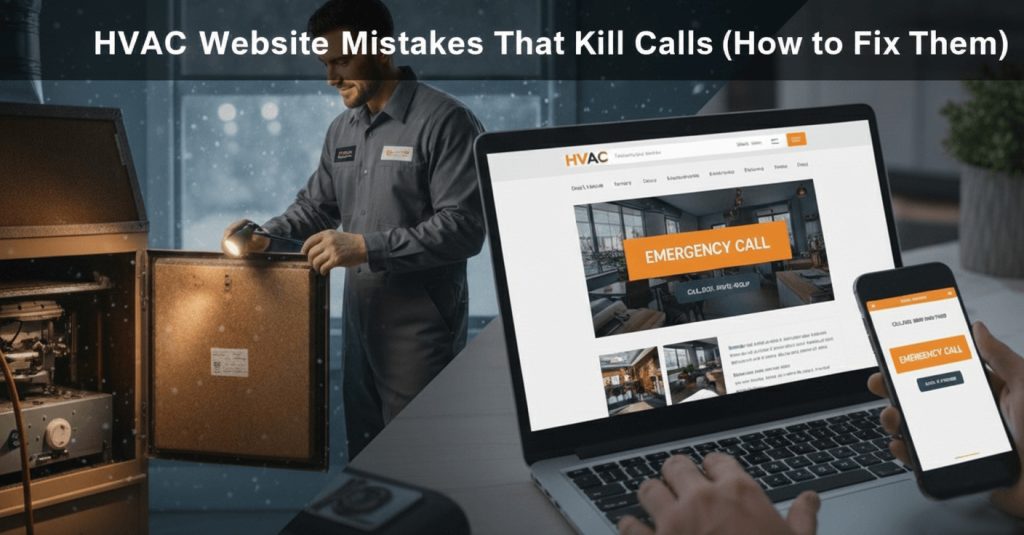
HVAC Website Mistakes That Kill Calls
HVAC websites fail to generate calls because they ignore how homeowners behave during real emergencies. When heat stops working, especially in Chicago extreme cold, visitors don’t read. They scan for reassurance, speed, and a phone number. If calling feels even slightly difficult, they leave within seconds.
If you’re not sure why your website isn’t ringing off the hook, this article is for you. We’ll dive into why your site lets customers down right when they need you most during a real emergency. You’ll learn how just a few tweaks to your mobile layout, trust signals, and call visibility can turn your site into a lead-generating machine.
8 Common HVAC Website Traps That Drive Customers Away
1. Designed for browsing, not urgency
What happens: People with no heat don’t read; they scan and bounce.
Do this instead: Build pages for emergency behavior and speed-to-call.
2. Poor mobile usability
What happens: Cold hands, tiny buttons, and slow load times = goodbye.
Do this instead: Use a mobile-first layout with big tap targets and fast performance.
3. Phone number buried on the page
What happens: Every extra second to find the number loses the lead.
Do this instead: Add a persistent click-to-call button, especially on mobile.
4. Contact forms prioritized over calling
Why it hurts: Forms delay response during furnace emergencies.
Fix: Make calling the primary CTA for urgent visitors.
5. Weak trust signals
Why it hurts: Homeowners judge credibility instantly.
Fix: Add real reviews, team photos, local cues, and brand consistency.
6. Generic template design
Why it hurts: “Same as everyone else” doesn’t win trust or calls.
Fix: Use custom design built for HVAC expectations and conversions.
7. Listing services instead of outcomes
Why it hurts: People want warm homes, not jargon.
Fix: Write around solving homeowner problems, not just listing services.
8. SEO and conversion treated as separate tasks
What happens: Traffic grows but calls don’t — wasted budget.
Do this instead: Combine SEO strategy with conversion-optimized layout and CTAs.
Why Your HVAC Website Isn’t Turning Visitors Into Phone Calls
Your HVAC website is not getting calls because it’s designed for browsing, not urgency.
In Chicago, where temperatures can drop to -30°F overnight, the “time-to-call” window is far shorter than in milder climates. Websites that fail to account for this lose calls even with steady traffic.
In cold-weather markets, homeowners arrive stressed and impatient. If the site delays trust, hides contact options, or loads slowly on mobile, the decision is made instantly and not in your favor.
Early in this article, it’s worth noting that this behavior is exactly what HVAC web design services in Chicago are built to address: emergency-driven decision patterns, not visual polish.
Fix Mobile Usability → Your Call Volume Will Jumps
Mobile usability is the most common failure point for HVAC websites. HVAC site usability problems usually include:
- ➤ Phone numbers are not immediately visible
- ➤ Tap targets that are too small for cold hands
- ➤ Slow pages frustrate emergency customers
- ➤ Navigation menus that bury contact options
While desktop layouts may look fine, they don’t reflect how homeowners search during winter breakdowns. Mobile-first simplification often reduces design flexibility, but it dramatically increases call volume over time.
If They Can’t Find Your Phone Number Fast, They Won’t Call
Call visibility should dominate the page hierarchy. HVAC website conversion issues often come from:
- ➤ Phone numbers only appearing once
- ➤ No persistent call button on mobile
- ➤ Forms prioritized over immediate calling
- ➤ Calls to action blended into long paragraphs
Forms are easier to track, but they slow response time. In emergency HVAC scenarios, homeowners overwhelmingly choose the fastest path to human contact. Optimizing for forms alone trades speed for control, and calls suffer.

What Happens When a Chicago Homeowner Loses Heat Overnight
When the furnace dies overnight in Chicago, urgency takes over. In most real cases, homeowners:
- ➤ Search on their phone while the house is cold
- ➤ Open multiple local contractor results at once
- ➤ Compare trust signals before reading details
- ➤ Call the first site that feels credible & fast
This pattern is common during Chicago winter outages. The site that surfaces a clear call option first often wins the job, regardless of service depth or pricing.
“HVAC websites don’t lose calls because of poor service quality. They lose calls because they aren’t designed for urgency.
In emergency situations, the site that reduces friction and surfaces a phone number fastest wins the job.”
— Keyvelopers Web Strategy Team
HVAC Website Design Problems That Reduce Trust Instantly
Trust is evaluated before content is consumed. HVAC contractor website problems often include:
- ➤ No clear local indicators or service-area cues
- ➤ Generic layouts that resemble template sites
- ➤ Testimonials without names, photos
- ➤ Brand should look the same anywhere online
Also, homeowners subconsciously compare your website against other trust anchors they encounter first, such as Google Business Profile listings and Google Local Services Ads results.
If your site feels less credible than those surfaces, calls drop even when rankings hold.
Using templates reduces upfront cost, but it also reduces perceived legitimacy. Over time, generic design patterns train users to hesitate.
HVAC Website Mistakes That Quietly Block Lead Generation
Some issues don’t look like problems until calls dry up. Common HVAC website mistakes include:
- ➤ Reviews are hard to find
- ➤ Wording doesn’t feel trustworthy
- ➤ Pages get visits but no calls
Getting found brings visitors, but design makes them call. If those two don’t work together, traffic grows without money coming in.
This is why modern HVAC web design services in Chicago focus on unified layouts that support both discovery and decision-making.
The Trade-Offs Most HVAC Contractors Don’t Account For
Every improvement carries a cost.
- ➤ Simple pages are clearer BUT less pretty
- ➤ Sticky call button BUT less minimal
- ➤ Fewer services BUT more focused
Ignoring these trade-offs leads to websites that look impressive but underperform financially.
REMEMBER :Effective HVAC websites accept these compromises intentionally.
When Professional HVAC Web Design Actually Becomes Necessary
Not every site needs a full rebuild immediately.
Professional HVAC web design becomes necessary when:
- ➤ Calls plateau despite stable impressions
- ➤ Mobile bounce rates spike during winter months
- ➤ Emergency traffic fails to convert
- ➤ Competitors with weaker services receive more calls
At this stage, surface-level tweaks rarely work. Structural alignment with homeowner behavior becomes the only reliable fix.
Conclusion: Why These Mistakes Keep Repeating
Most HVAC websites fail because they are designed in isolation from urgency. Contractors don’t lose calls due to poor service. They lose calls because their websites don’t function like emergency tools.
Understanding how homeowners behave under pressure is the difference between traffic and calls. That understanding is what professional HVAC web design services in Chicago are built around.
FAQ
1. Why isn’t my phone ringing?
Because your visitors are freezing and stressed. They aren’t there to read—they’re scanning for a “Call Now” button. If they have to hunt for it, they’re gone in seconds.
2. What’s the biggest mobile mistake?
Tiny buttons and slow speeds. If a homeowner has to pinch-to-zoom just to find your number with cold hands, they’ll just click the next contractor on the list.
3. Do I still need contact forms?
Only for non-emergencies. Nobody fills out a form at 2 AM when their pipes are about to freeze. Make your phone number the biggest thing on the page.
4. How do I win their trust fast?
Stop using stock photos. Show your real trucks, your team, and mention your specific Chicago neighborhoods. People hire locals they can actually recognize.

keyvelopers is an SEO & AI search strategist specializing in Semantic SEO, entities, and GEO‑focused optimization.