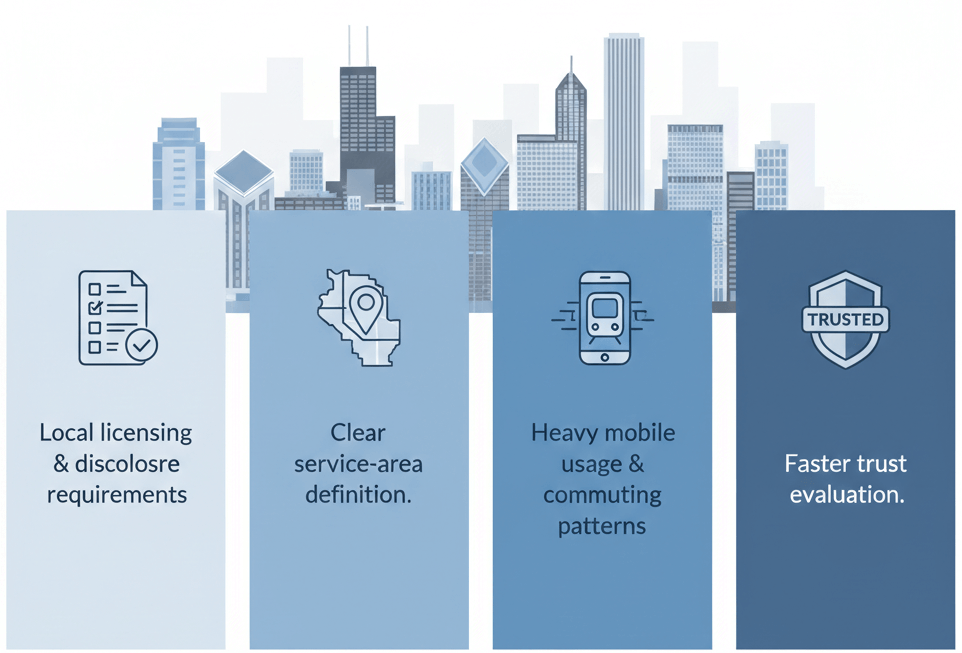
Small business web design in Chicago refers to planning and structuring business websites that align with local market behavior, operational realities, and long-term growth demands. This page exists to help Chicago small business owners choose the right website approach, avoid common structural mistakes, and understand the constraints that matter most in this market.This page intentionally does not cover pricing, templates, or step-by-step build instructions. Those topics are addressed in dedicated supporting guides linked below. The focus here is decision quality, not execution details. This framework reflects recurring patterns observed across Chicago small businesses operating under dense competition, high comparison behavior, and city-specific disclosure expectations.
Why Small Business Web Design in Chicago Is Not One-Size-Fits-All
Small business websites in Chicago fail most often when they are designed without regard for local competition, customer behavior, and operational pressure.
In Chicago, users compare providers quickly, abandon unclear sites faster, and rely heavily on mobile search. Trust signals, speed, and structural clarity consistently outperform visual novelty. A site that performs adequately in a smaller or less competitive market often underperforms here because it does not account for higher scrutiny and tighter decision windows.
Selling Online Adds a Different Layer of Complexity
Ecommerce introduces requirements standard business sites do not face.
Payment processing, inventory logic, tax handling, and fulfillment workflows all influence design decisions early. Treating ecommerce as a visual add-on often leads to rebuilds. Ecommerce-specific planning is detailed in ecommerce solutions for small businesses in Chicago
Maintenance Is a Structural Decision, Not an Afterthought
Many failures blamed on “bad design” are actually maintenance failures.
Common Misconceptions About Small Business Web Design
In real situations, businesses often:
➤ Assume low-cost templates are easier to fix later
➤ Prioritize visuals over structure and clarity
➤ Delay maintenance planning until issues appear
Each assumption increases long-term cost and limits flexibility.
When Small Business Web Design Is Not the Right Fit
Not every business needs a full custom website immediately.
Very early-stage businesses without validated offerings may be better served by temporary solutions. Businesses undergoing major internal changes often struggle to maintain a site mid-transition. In these cases, premature investment usually results in rework rather than progress.
Choosing a Web Design Partner Without Guesswork
This page is not intended to recommend a specific provider. However, when search results are dominated by service pages, decision clarity matters.
When evaluating a web design partner, consider whether they:
Discuss structure and long-term scalability, not just visuals
Plan for maintenance and growth from the start
Account for local search behavior in design decisions
Have experience with businesses similar to yours in complexity and market
This reference is provided for context only, not comparison.
Which Path Fits Your Situation
Budget sensitivity → lean, scalable foundation
Mobile-heavy traffic → responsive-first structure
Ecommerce required → plan operational complexity early
Local visibility priority → search-oriented design
Anticipated growth → avoid rigid templates
How This Goes Wrong (A Pre-Mortem)
➤Failure pattern: speed over structure ➤Early warning sign: pages added without a plan ➤ What breaks: navigation and clarity ➤ Long-term consequence: expensive restructuring
➤ Failure pattern: maintenance ignored ➤Early warning sign: updates postponed ➤What breaks: security and performance ➤ Long-term consequence: loss of user trust
Assumptions & Constraints
➤ Small to mid-sized Chicago-based business
➤ Moderate to high local competition
➤ Limited internal technical resources
➤ Sensitivity to long-term maintenance effort
Terminology Normalizer
Responsive Design
layouts that adapt across devices
Scalability
ability to grow without rebuilding
Technical Debt
future cost from short-term decisions
Maintenance
ongoing updates and monitoring
Conversion Clarity
ongoing updates and monitoring
What to Collect Before You Talk to Anyone
➤ Existing site assets and access
➤ Service priorities
➤ Known constraints or deadlines
➤ Decision-makers involved
➤ Local licensing and compliance needs
If You Remember Nothing Else
01
Structure beats visuals
02
Chicago users compare quickly
03
Scalability must precede launch
04
Maintenance is non-negotiable
05
Careful planning costs less than rework
Utility Resource
Download the Chicago Small Business Website Readiness Framework to confirm whether your current website approach matches your business stage.
Visual Comparison Asset
Comparing Website Approaches for Chicago Small Businesses
Primary Goal
Best-Fit Approach
Key Constraint
Long-Term Impact
Launch quickly with limited budget
Lean, modular website structure
Limited flexibility at start
Easier expansion without rebuild
Maximize local visibility
Search-oriented site architecture
Requires content planning
Stronger long-term rankings
Sell products online
Ecommerce-first design
Higher operational complexity
Fewer rebuilds as inventory grows
Support multiple services
Scalable content hierarchy
Upfront planning effort
Reduced technical debt
Minimize maintenance risk
Maintenance-aware architecture
Ongoing update discipline
Improved stability and trust
Meet the Expert
Omid Mohsenian is a Senior Strategist at Keyvelopers with first-hand experience analyzing small business website costs in Chicago. His work focuses on how pricing is shaped by scope decisions, development hours, and compliance realities, including familiarity with Chicago regulatory agencies and the operational challenges faced by local businesses. LinkedIn: https://www.linkedin.com/in/omid-mohsenian-34422b4a/